Data centers in transition: What role does ENGIE Refrigeration’s cooling portfolio play?
Year after year, Data Center World in Frankfurt showcases the direction in which the international data center market is heading. ENGIE Refrigeration is on site at the joint booth with ENGIE Germany, and Jürgen Martin, Key Account Manager for Data Centers at ENGIE Refrigeration, explains which technological trends are currently shaping the market – and how ENGIE Refrigeration’s product portfolio fits in with this – and why it is, of course, well worth visiting ENGIE Refrigeration at stand H102 in Frankfurt.
Jürgen, in your view, what key developments can we expect at Data Center World in Frankfurt?
Jürgen: We are certainly seeing an increasing concentration of technical solutions among individual suppliers. Many market players no longer present isolated components, but complete portfolios: cooling, air distribution, liquid cooling and control systems all from one single source. The market is increasingly demanding integrated solutions that are easy to plan, operate and scale.
For specialists such as ENGIE Refrigeration, this does not mean that traditional cooling technology is losing its importance – on the contrary. It remains a central backbone of modern data centers, but must increasingly be embedded within overarching concepts.
Another major issue is the scalability of data centers. How should this trend be interpreted?
Jürgen: Scalability is currently one of the dominant topics. Many data centers today are no longer built in their entirety at once, but are expanded modularly, often based on container solutions. Colocation providers, for example, start with a ten-megawatt data center and expand it step by step – depending on customer requirements – quite simply by adding further modules.
This is a highly relevant field for ENGIE Refrigeration. With our GENIUM cooling containers, we can support precisely these expansion models. Our containers can be designed to ‘grow’ alongside the data center without the need for significant oversizing from the beginning.
What role does our existing product portfolio play here?
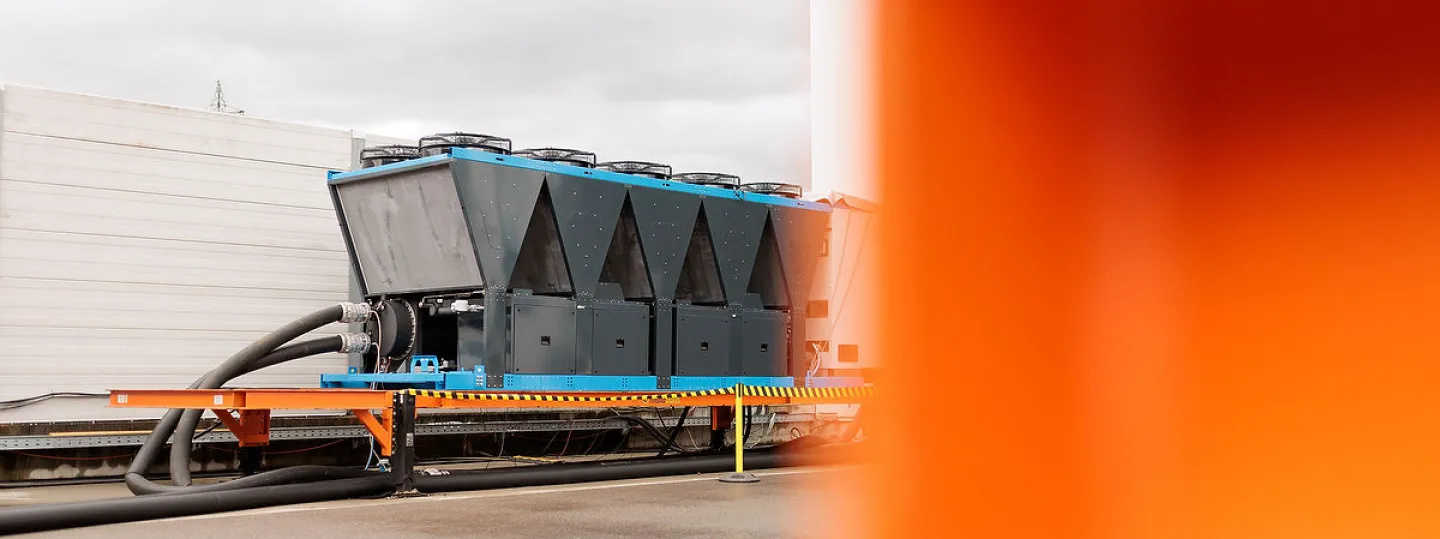
Jürgen: Our portfolio is very well suited to these requirements. Chillers remain state-of-the-art, both for traditional air cooled data centers and to support hybrid concepts. Our compact and modular container solutions are particularly attractive to the data center market because they can be integrated in flexibly.
A good example is our QUANTUM Air chiller, developed specifically for data centers, in which many components – such as free cooling and pump modules, soundproofing packages, hydraulic system separation and harmonic filters – are already integrated. This significantly reduces planning and installation effort and is therefore even better meeting the requirements of modern data center projects.
How do you assess the current state of liquid cooling?
Jürgen: Liquid cooling will certainly be a key topic at this year’s Data Center World, but it is not yet a widespread standard. In reality, many data centers continue to operate using traditional air cooling. Liquid cooling is primarily used where very high power densities are required, such as in specialised high-performance applications or AI clusters.
It is important to note that even in these scenarios, the chiller does not disappear. It remains necessary to reliably maintain temperature levels. Our existing chillers can already cover temperature ranges that are also relevant for certain liquid cooling applications.
Can you give us a specific example of an application that illustrates the importance of natural refrigerants in the data center environment?
Jürgen: A prime example is a high-performance data center near Stuttgart. At the heart of this project is a holistic energy concept in which the waste heat from the supercomputers is systematically utilised and integrated into the existing district heating network.
ENGIE Refrigeration is supplying a total of eight thermeco2 high-temperature heat pumps for this purpose. A key technical factor here is the use of CO₂ as refrigerant, which is classified as safety class A1 in accordance with DIN EN 378 and is therefore non-flammable.
This is a significant advantage, particularly in a safety-critical environment such as a high-performance data center. At the same time, CO₂ enables very high efficiency levels when raising waste heat to a usable temperature. This means that a considerable proportion of the campus’s heating requirements can be met using the waste heat generated in the data center.
The project serves as a prime example of how ENGIE Refrigeration’s portfolio can combine cooling, heat recovery and energy recovery in a technically sound manner – enabling a considerable proportion of the campus's heating requirements to be met by waste heat from the data center, reducing primary energy demand.
You also mentioned the market for existing data centers. Why is this market so relevant?
Jürgen: The market for refurbishment and modernisation is set to grow significantly. Many existing data centers will need to be upgraded in terms of energy efficiency and technology in the coming years. However, not every data center will be completely converted to new cooling concepts.
This is precisely where one of ENGIE Refrigeration’s great strengths lies: our chiller ranges are ideally suited for the refurbishment of existing systems because they integrate well into existing infrastructure whilst delivering efficiency gains.
Your conclusion today is……
Jürgen: The market around data center equipment is evolving rapidly – but cooling technology will remain an indispensable component of modern data centers. With its product portfolio, ENGIE Refrigeration is very well positioned, both for new buildings and for modernisation projects.
The key task for the future will be to embed our technical strengths even more firmly within holistic solutions. Technologically, we are ideally equipped for this.
Thank you very much for the fascinating insights, Jürgen Martin!
In summary: Cooling technology for modern data centers!
Cooling technology for modern data centers – scalable, efficient, AI-ready
Demand in the data center market is increasing due to AI workloads and rising power densities. ENGIE Refrigeration provides tailor-made cooling solutions with a modular design for data center applications.
Our GENIUM cooling containers support flexible, modular expansion concepts and grow alongside the data center. QUANTUM Air delivers maximum efficiency through integrated free cooling, pump modules and acoustically optimised components – perfect for modern data center architectures.
For AI clusters and high-density cooling, our systems cover the relevant temperature ranges – including for liquid cooling concepts. Alternative refrigerants such as CO₂ (R-744, GWP = 1, ODP = 0) offer specific environmental advantages over high-GWP fluorinated refrigerants and additional safety benefits due to their non-flammability (safety class A1 per DIN EN 378).
Our units also excel in the retrofit market: they can be easily integrated into existing infrastructures and enhance efficiency and operational reliability.
Conclusion: Whether for new builds, high-density AI setups or modernisation – ENGIE Refrigeration delivers scalable and future-proof cooling solutions for modern data centers.
Articles you might also be interested in
Heat Recovery in the Food Industry: Technologies, Potential, and Funding Opportunities
Most food processing companies effectively pay for energy twice: once for cooling and once for heating. Yet the heat is already generated as a by-product of the cooling process and is often discharged unused every day. The largest untapped energy resource in food production facilities is not externally supplied renewable energy, but rather the waste heat already produced within the process itself. By systematically harnessing heat recovery, companies can reduce primary energy consumption and CO₂ emissions without compromising product quality or operational reliability.
Best practice at ENGIE Refrigeration: How AR glasses are opening up new perspectives for industry
What added value can AR glasses generate for the industry? We demonstrate this at ENGIE Refrigeration as a pioneer in the cooling and heating industry. With Augmented Reality (AR), we are opening up new possibilities for our chillers and heat pumps in numerous areas of the company. Our experts from various areas of the company report exclusively in the ‘on point’ magazine on how our organisation and, above all, our customers benefit from this in concrete terms – and make it clear that there is enormous potential in the use of AR glasses in industry.

Robust refrigeration technology for the navy, cruise ships and ferries: Ship ahoy with MARENUM!
Reliable and efficient chillers have long been part of the basic equipment of modern ships. However, special conditions apply on the water that differ from the usual requirements on land. Daniel Keller, Head of Sales & Business Development at ENGIE Refrigeration, explains what characterises refrigeration technology for the navy, cruise ships and ferries and what advantages our MARENUM chillers offer for various types of ships. He also provides exciting insights into three reference projects.

Trends in the IT sector: from sustainability requirements to edge data centres
Trends revitalise the IT sector. This is because they drive innovation, secure competitive advantages and enable long-term business success. As a cooling and heating expert for data centres and especially for edge data centres, ENGIE Refrigeration knows current trends inside out - and is even ahead of them thanks to future-oriented technologies. Jürgen Martin, Key Account Manager Data Centres at ENGIE Refrigeration, shares his expert assessment of the most important market developments in the data centre sector in 2025.

Refrigeration technology with future potential: GENIUM container in data centres
Data centres are the central infrastructure for the digital world. While our life today is largely controlled by the use of digital technologies, the operation of modern servers and IT hardware is only possible with a flexible cold supply. Jürgen Martin, Key Account Manager Data Centres at ENGIE Refrigeration, explains why our GENIUM container is the perfect basic equipment for a data centre.

Augmented reality in industry: how AR glasses are revolutionizing the cooling and heating market
Innovative strength and business success go hand in hand at ENGIE Refrigeration. This is why the refrigeration and heating specialist from Lindau at Lake Constance relies on the use of state-of-the-art technologies such as AR glasses in the development of refrigeration machines and heat pumps. Tatiana Köhler, Head of Marketing and Communication, and Jörn Stiegelmeier, Head of Technology and Development, reveal the potential of augmented reality in industry for various areas of the company.
Tailor-made solution for data centres: 16 water-cooled QUANTUM chillers in a container ensure whisper-quiet operation and energy-efficiency
16-fold chiller power in the Netherlands: ENGIE Refrigeration proves that operational reliability and high-end technology in data centres work best with water-cooled chillers for a large, internationally active provider in the field of large data centres: 16 QUANTUM Water models in a GENIUM container promise outstanding efficiency and whisper-quiet operation. Jürgen Martin, Key Account Manager Data Centre at ENGIE Refrigeration, reveals exciting details about the project
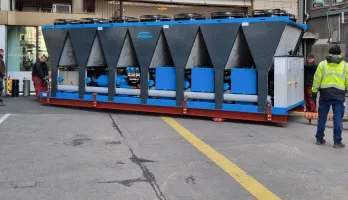
Customised rental cooling: QUANTUM air chillers offer flexible, low-refrigerant-charge performance for major radio and television broadcaster
Customisable and adaptable to a range of application requirements: rental chillers can be used to provide temporary cooling capacity in a wide range of applications. In the studios of a public broadcaster in Germany, ENGIE Refrigeration proves how precisely rental refrigeration can be integrated into existing environments, even under demanding conditions. Hans-Werner Barkhofen, Head of Service Germany West at ENGIE Refrigeration, talks in an interview about the challenges and opportunities of rentable refrigeration solutions.
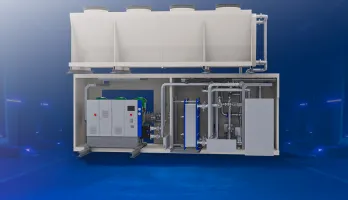
Ten in one: QUANTUM chiller and SPECTRUM heat pump provide pioneering momentum for data centres
Digitalisation is one of the economic megatrends of our age. Most businesses are reliant on smooth-running information technology (IT) – and thus on data centres, the IT all-rounder. How can a sensitive digital infrastructure be operated as safely, reliably and energy-efficiently as possible? With its QUANTUM chiller and SPECTRUM heat pump, ENGIE Refrigeration now takes care of ten local data centres belonging to a German provider – and is breaking new ground for the IT industry in the process.
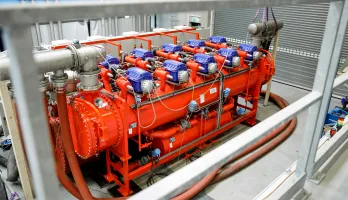
QUANTUM P shows its full potential at chemicals industry giant
Erring on the side of caution – in the chemicals industry in particular, this is a number-one priority for many areas. One area that is highly sensitive is production. A German chemicals industry giant recently approached ENGIE Refrigeration to help fulfil its need for an industrial refrigeration system at its production site in Singapore – one characterised by absolute reliability.