
Efficient cooling and heating for milk production – with heat-cold coupling and CO₂ as refrigerant
Nothing works in the dairy industry without the right temperature. An exact cooling and heating supply is not only decisive for the quality of the products, but also for the efficiency and the reduced CO₂ emissions of the production compared to conventional fossil-fuel-based heat generation. With the thermeco2 high-temperature heat pump, dairies benefit from simultaneous heat-cold coupling, the use of CO₂ as a refrigerant (GWP = 1) and high efficiency values even under extreme operating conditions.

Process heating and cooling supply in milk production
When milk production relies on heat-cold coupling with low-GWP refrigerants and high energy efficiency – then the cooling and heating solutions from ENGIE Refrigeration are certainly in play.
Energy-efficient greenhouse heating with the thermeco2 high-temperature heat pump
Heating your greenhouse in a future-proof way is in the interest of many operators. A specialty of ENGIE Refrigeration: At the Osatina Group, a leading food manufacturer from Croatia, ten thermeco2 high-temperature heat pumps provide an energy-efficient heat supply using CO₂ as a refrigerant (GWP = 1) in five greenhouses.

Precise supply: High-temperature heat pump in chocolate production
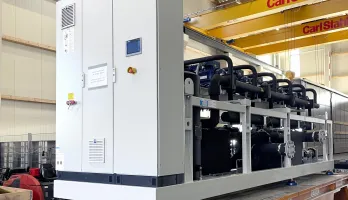
A thermeco2 high-temperature heat pump (type: HHR 360) ensures the ideal temperatures in chocolate production at Riegelein in Cadolzburg.
Dairy industry: pinpoint cold and heat as a recipe for success
In food industry, the production of dairy products is considered particularly energy-intensive. There is a high demand for process heat in the production of milk powder, for example, which requires industrial drying processes in the medium temperature range of 100 to 200 degrees Celsius. This is because in order to convert the usually pre-concentrated product into a high-quality powder, it must be evaporated in the hot drying gas streams of a spray dryer. The necessary temperatures are usually generated by burning fossil fuels - the CO2 emissions are correspondingly high. In addition to the generation of heat, the cold water supply plays a central role in industrial milk powder production. To increase the efficiency of a spray tower, for example, the humid supply air to the dryer is dehumidified in summer. Processing of raw milk is just as temperature-sensitive. For the production of UHT milk or ESL milk as well as for pasteurisation, heat treatment processes are used in dairies on a daily basis. This is followed by rapidly cooling the milk to counteract the growth of bacteria. A technical solution that easily masters the balancing act between heat and cold in both production processes and guarantees sustainable milk production is therefore indispensable in dairies.
thermeco2: our all-round talent for any temperature
At ENGIE Refrigeration, we provide the targeted answer for simultaneous heating and cooling in milk production with thermeco2 – using CO₂ as a refrigerant (GWP = 1) and achieving high efficiency values across a temperature spread of up to 120 Kelvin. Thanks to heat-cold coupling, our high-temperature heat pump unfolds its full potential precisely when heat and cold have to be on the spot at the same time - and thus offers the best conditions for future-oriented milk production with simultaneous heat-cold coupling, a temperature spread of up to 120 Kelvin, and CO₂ as a refrigerant with a GWP of 1. Even large spreads between the cold and the warm side of up to 120 Kelvin are no problem for the thermeco2 thanks to the refrigerant CO2 in one stage.
Sustainable milk production? No worries.
With the thermeco2 high-temperature heat pump, dairies can significantly reduce their CO₂ emissions compared to conventional fossil-fuel-based heat generation. This is made possible above all by CO₂ (R-744) as a refrigerant – with a Global Warming Potential (GWP) of 1, no ozone depletion potential, and no legal restrictions under the F-Gas Regulation. In terms of economic efficiency, the refrigerant also offers high added value, as it is not subject to any legal restrictions, waste and recycling requirements or availability limitations. In addition, CO2 as a refrigerant guarantees low maintenance requirements. Safety for system operators is also a top priority.
Read more about thermeco2 and its technical features directly.